Susan Jo Russell’s article Developing Computational Fluency with Whole Numbers
Principles and Standards for School Mathematics by The National Council of Teachers of Mathematics
The Flexibility Formula K-2 course
The Flexibility Formula 3-5 course
Go to the YouTube video to leave your comments: https://youtu.be/RyPHSFuXQyM
Welcome fellow Recovering Traditionalists to Episode 225: The New Math Fluency Standards That Were 26 Years in the Making
For the past 15+ years I’ve been doing trainings on how number sense impacts students’ math fluency and in every single presentation I reference Susan Jo Russell’s article Developing Computational Fluency with Whole Numbers that was published in 2000.
In that article, she laid out the three pieces that truly signal you are fluent:
Accuracy
Efficiency
Flexibility
Now, I know those originally were talked about in the book Principles and Standards for School Mathematics by The National Council of Teachers of Mathematics, but that book has a lot of info and Susan’s article was specifically about fluency so I tend to direct people to her article. And now after 26 years, that 3 part definition of fluency is FINALLY making their way into the state math standards!!
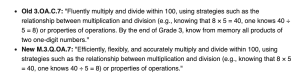
The Washington State Mathematics Council recently sent out an email and it included information about the change in their fluency standards in their new Learning Standards for Math. This is a screenshot directly from that email that shows the change that has taken 26 years to come to fruition:
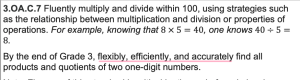
But the amazing thing is that it isn’t just Washington State. I’ve been working with the state of Iowa and bringing The Flexibility Formula to all their teachers and even before working with me they had updated their math standards to include wording that laid out what “fluently” really means:
And even in my home state of Idaho, they didn’t change the wording of the actual standards to include the 3 parts, but they did go in and add clarifications. Here’s the one for multiplication & division fluency:
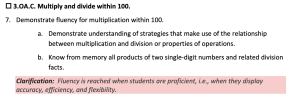
This is such a positive step towards fluency development and I can not tell you how excited I am about this. I’d love to hear if your state has made this change in the fluency standards. Email me or leave a comment on the video in YouTube.
Okay for anyone new here, why is this distinction so important?
I like to use the analogy of cooking. When I cook, I need to follow a recipe. If I don’t follow the recipe, it will not turn out well. I have to follow the recipe. And if I don’t have all the needed ingredients that the recipe lists, I can’t make that recipe. When I cook, I have to follow a recipe. But if you came to my house for dinner, you would not know that, because I produced the end product of a delicious meal on the table. Well, my kids may not say it’s delicious but that’s besides the point.
Now let’s compare that to the way that my mother cooks. She sometimes doesn’t even use a recipe. But if she is using a recipe, she is the type of cook who, when she’s looking at it, is like, “Oh, if I just add a little bit of this or a little bit of that, it’s going to make it so much better.” She is tasting it along the way and then making decisions as she goes about what might be needed to make it even better.
Now we both produce the end product of a meal on the table, but hers is done flexibly. She is accurate, she’s efficient, and she’s flexible. When I cook, I am accurate and efficient. I get the job done, but I also have roadblocks that my mother does not have. If I don’t have exactly what’s in that recipe, I cannot make it.
And that is what happens to our students who are only doing math accurately and efficiently. If they don’t have flexibility, they look like they are able to produce the end product…until they can’t. Because they have those barriers. They end up being stopped by something that they cannot go past because they don’t have the necessary ingredients. For example, kids who only know the procedure, and if the procedure isn’t working right or they forget a step, they can’t move past that.
So which do we want for students? Do we want them mindlessly following a recipe or actually thinking flexibly?
It’s the difference between a kid who sees 10,000 – 9876 and lines it up to do the standard algorithm because that’s the recipe they know versus a kid who sees that same problem and decides to add up from 9876 to 10,000 because they have a flexibility with numbers and see it’s a more efficient way.
The standard algorithms do work great, just like recipes…but there are a lot of times we need to be flexible thinkers not just do-ers.
When I started writing this out today I had no plans of talking about my online course for math educators called The Flexibility Formula I really just wanted to say how excited I am that states are FINALLY including Susan Jo Russell’s definition of fluency even if it has taken 26 years….but I do know that there might be some of you who watch this and at the end think, “okay, so how do I move from just accuracy & efficiency to helping students build flexibility?” Well that’s what my online course The Flexibility Formula is all about. You can go to BuildMathMinds.com/enroll to learn more. There is a course for K-2 educators that guides you through what it takes to build your students’ flexibility with numbers 0-20 in relation to getting them fluent with addition and subtraction facts and then the 3rd-5th grade course is about building students’ flexibility with whole numbers and fractions to help them be computationally fluent with all the operations. So go to BuildMathMinds.com/enroll to enroll in Lifetime Access for just $97. If you want to make a big change and get a whole school, district, or even your state (like Iowa is doing) into the course email me at info@buildmathminds.com.
And if you aren’t familiar with Susan Jo Russell’s article I’ll link that up below. That link will go to the NCTM version of the document because that’s where it was published. If you Google it, you can probably find a version Susan has posted elsewhere that anyone can access.
On the off chance that Susan ends up listening to this I personally want to say THANK YOU. That article was one that impacted my own thoughts about mathematics and has impacted the trainings I provide to educators. Susan, this idea of fluency being more than just getting correct answers quickly, has taken a long time to take its hold, but man you have impacted so many educators along the way to this moment and so many students are going to have such a different math experience moving forward due to your article.
And so in the comments, I’d like two things:
- Say thank you to Susan Jo Russell, her work has most likely impacted so many of you who listen to me and let’s thank her for that
- Then, post what state you are in and whether or not they have made a change in the fluency standards to include Susan’s three parts: Accuracy, Efficiency, and Flexibility
Alright, my fellow Recovering Traditionalists, I hope this helped build your math mind so you can build the math minds of your students.
Subscribe and Review in iTunes
Other Ways to Listen To This Episode




Pin This To Pinterest for Later