Register for the FREE Virtual Math Summit
Join the Build Math Minds PD site to access summit sessions after the free access is over
Welcome fellow Recovering Traditionalists to Episode 224, Mathematical Residue – What Stuck After the Virtual Math Summit
Now there’s this phrase called “mathematical residue,” and I honestly cannot remember what book that’s from. If I probably did some digging, I know I could find it, but…we wrapped up the Virtual Math Summit last weekend, and my brain honestly has been fried.
I am still processing physically and mentally the summit sessions. We have to go through them all and get them separated into individual sessions because it was like a giant live stream. I hope you guys liked it. I enjoyed the giant live stream.
So anyway, my brain still has not caught up and is not ready to move on to other things. But I do remember the phrase “mathematical residue.” It’s this idea that once you’re done with a lesson, we have this idea in our mind about hitting a certain objective for the lesson. But what the students actually take away from a lesson is what they call the mathematical residue-what gets left behind from what you did.
So that’s what I’ve been looking at this week around the Virtual Math Summit. Once it was over, we sent out a survey to everyone who had signed up, asking for big takeaways, favorite speakers, things that they liked about the summit, and things they didn’t like. I thought I would share a few things, because this weekend is your last chance to watch the sessions.
Normally I do these episodes on a Sunday. Last Sunday we wrapped up the Virtual Math Summit and I had no capacity to do an episode for you. I thought it wouldn’t do you much good if I waited until this Sunday to do it, because Monday is the last day you can watch sessions for free. So if you have not signed up, you still can. Go to VirtualMathSummit.com, get registered, and we’ll send you the link to the replay page. You can start binge watching this weekend. If you are signed up, go look…we’ve sent you an email with where to go to watch the replays.
A few things I want to tell you about. Number one: in the two days that we did the summit live, it was over a million minutes of professional development watched. A million minutes. And that’s not even counting this week since it’s been available for replays-that was just during the live time. So that’s over 17,000 hours of PD in just one weekend. That’s how amazing it was.
And #2 – In the survey, there were lots of people who said they couldn’t pick a favorite, that it was all so amazing. But there were some themes that kind of stuck out-what residue people were taking away from the weekend. That’s what I want to share with you, to encourage you to go watch some sessions. Maybe you’ll walk away with some of this residue as well.
The importance of listening to and understanding student thinking over just looking for the correct answer.
The first thing that came out as a big theme was the importance of listening to and understanding student thinking, instead of just looking for an answer. We talk about it a lot, but there were some really actionable sessions that gave that information. I didn’t pick certain ones to talk about-I mean, the keynote by Graham Fletcher was all about that-but so many presenters shared ways you can make that happen, giving you practical ideas of how you can actually listen to student thinking. Because it seems like, “Oh yeah, that’s a great idea,” but how do you actually put that into practice? There were lots of presenters who gave ideas around that.
The use of AI to enhance our jobs (Dr. Kristopher Childs & Dr. Nicki Newton)
There were two presenters-one of which was a keynote and one was in the coaches’ session-about the use of AI, and there were a lot of ideas given. I remember seeing one of the comments-I didn’t get a screenshot of it-but one of the educators who was watching Dr. Childs’ keynote said, “Wow, AI could be used for more than just cheating.” I feel like that is kind of the common thing in education-we’re trying to combat AI because our students are using it to cheat. Throughout these two sessions, lots of people saw how AI could potentially enhance our jobs, not do our jobs for us, but enhance them. But in both sessions it was always reiterated that AI is not the smartest person in the room-you always have to double check it, triple check it. And then of course there are the concerns about AI and the environment and all of those pieces that we have to be watchful and mindful of as well. But if you’re curious about how AI can enhance the job of an educator, take a look at Dr. Childs’ session, which was in the keynotes, and Dr. Nicki Newton’s, which was in the coaches’ sessions.
The confidence to start implementing right now-even if we don’t know it all, we can learn as we go…students need the benefits now.
A common theme that I saw throughout the chat, and that also came out in the survey, was that throughout the sessions, presenters were giving educators the confidence to just start implementing right now. You do not need to wait until you know everything because A, it’s impossible to know everything, let’s be honest, and B, your students need you to start implementing this stuff now. They can’t wait for it.
So there was a lot of talk about being okay not knowing everything, being okay if you try something and it doesn’t work out, and being okay with being imperfect in your implementation as you’re starting out. Because just opening up the classroom to explore some of these things is going to have so many benefits for your students, even if you’re not doing it “right” the first time-because who says what’s the right way to implement those things? Again, I can’t point you to a certain session for that because it just seemed to be a common theme throughout. I know I was facilitating all the coaching sessions and the keynotes, and I saw that over and over again in the comments: “It’s okay to just try it. I’ve got to get going-my teachers need this, my students need this right now.” So the confidence to just start.
Being able to incorporate more joyful and engaging tasks…attendees walked away with a lot of ideas to use right now on various topics.
Another one that was common throughout a lot of sessions-so there’s not a specific one to point you to-was meaningful, joyful, and engaging tasks. All the attendees were talking about how they got things they could use right away in their classroom. This would be specific to you, which is why I’m not pointing to certain ones. But if you’re working with fractions coming up soon, there was stuff about fractions. If you’re working on getting kids to decompose numbers and think about place value and all the ways you can break apart numbers, there were sessions on that. There were sessions on counting, sessions on geometry-John SanGiovanni’s session on routines for geometry, measurement, and data was just chock full of routines. If you don’t have stuff for geometry, measurement, and data, go check his out for sure. But whatever topic you’ve got coming up or that you might need some fresh activities for, go look at the schedule and see who you should go watch.
The neuroscience of how the brain works and how children develop their mathematical understandings (Becky Lord & Douglas Clements)
Becky Lord and Douglas Clements were mentioned throughout the survey quite a few times-how cool it was to learn about the neuroscience of how the brain works and the science of how children develop their mathematical understanding. There was a lot of talk about the science of math. So if you’re wondering what science says about how children are learning mathematics, go check out Becky Lord’s and Douglas Clements’ sessions.
Using bite-sized PD to help achieve the 80/20 principle…bite-sized PD for 80% allows you extra time to work deeply with those 20% of your teachers who are the Innovators & Early Adopters (Christina Tondevold & Alisha Frausto)
The final two I’m going to talk about were from the coaching sessions. It feels a little weird because one of them was my own, so it feels weird to talk about my own stuff-and it got mentioned a lot. In my session, we talked about three key shifts you can make as a coach. One of them was using the 80-20 principle. The reason that stuck with people was because they saw connections to it throughout a lot of different sessions, including Alisha Frausto’s session. Alisha’s got mentioned over and over again, and I’m still thinking about her session and how we could start implementing and creating some bite-sized PD stuff for our members inside of Build Math Minds so that you don’t have to create it yourselves.
Her session was so amazing. The bite-sized PD that Alisha talked about really allows you to still work with the 80% of teachers who aren’t going to benefit as much from you going so deeply with them the way the 20% will. I had talked about using the 80-20 principle to help you decide who you’re going to go deep with, and Alisha’s session talked about how to still reach all of the teachers you’re working with. It was just a really cool connection between the two.
There were so many comments throughout the entire weekend about how their mind was blown about certain things. I heard it from the other facilitators in the PreK–2 and 3–5 tracks, and I saw it multiple times in the coaching sessions-how inspired people were and how they couldn’t wait to get back and try things right away.
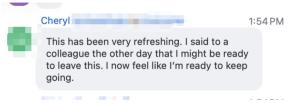
But there was one comment I want to leave us with. Out of all the comments throughout the entire weekend and the emails coming in-and I appreciate hearing every single one-one of them just really stuck out to me. It was from an attendee named Cheryl. Cheryl said: “This has been very refreshing. I said to a colleague the other day that I might be ready to leave this. I now feel like I’m ready to keep going.”
You guys, that almost brought tears to my eyes.
I started the Virtual Math Summit because I wanted to help educators build their understanding of mathematics and how children learn mathematics. But the byproduct that I wasn’t even thinking about was the validation and inspiration that so many of you have received when you come to the Virtual Math Summit. It’s just been very powerful to see the impact that these presenters have had on all of you.
I really want to thank everyone who showed up to the summit. You gave up your time, your energy, your mental capacity for an entire weekend to come learn, and I am so thankful you did. I’m also so thankful to our presenters who have helped lift you up, because the job that you are doing right now is so tough. So many of you feel the same way as Cheryl, “can I keep doing this year after year?”
I’m honored that the Virtual Math Summit has been a part of your journey and a part that has made you feel like you can do this. You’re in the right spot. You’ve got what it takes to make a difference in the classroom you work in, the school you work at, and with your colleagues.
Thank you from the bottom of my heart for another amazing Virtual Math Summit-the 10th time we have run it.
So my fellow Recovering Traditionalists, as I always say, there is still time to go build your math mind at the Virtual Math Summit so you can build the math minds of students. It is still free until Monday, March 9th at 10pm Pacific. After that, we switch things over so that our BMM members, the members of our Build Math Minds site, have access. VIP access is no longer available to purchase; that was only through the summit. So if you want to continue this journey, build your math mind, build your understanding, and get resources to help you along the way, come join us inside the Build Math Minds PD site at BuildMathMinds.com/BMM
Otherwise, get out there and go watch these free sessions. We put them out there for free for 10 days so that you are not limited by price. Go watch some. Go change how you think about the learning and teaching of mathematics.
I will see you again next week.
Subscribe and Review in iTunes
Other Ways to Listen To This Episode




Pin This To Pinterest for Later