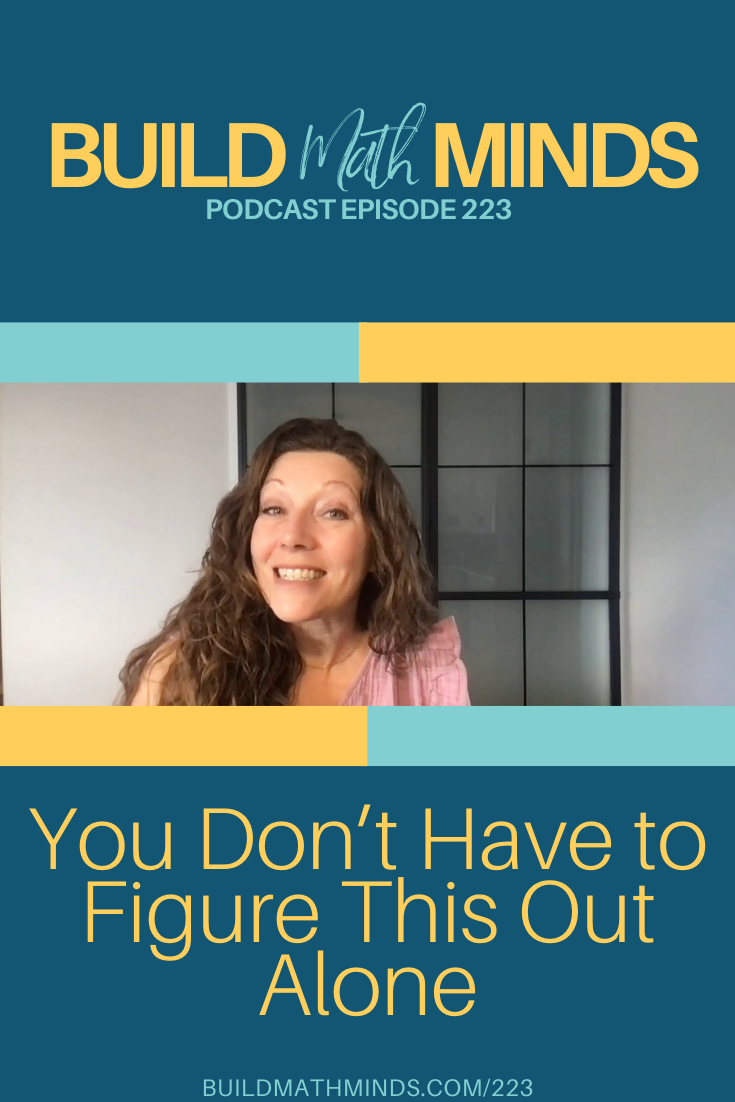
Welcome fellow Recovering Traditionalists to Episode 223, You Don’t Have to Figure This Out Alone (And That’s the Real Reason to Come to the Virtual Math Summit)
The 2026 Virtual Math Summit starts this next weekend. And I know a lot of you are on the fence about attending or heck, even registering – you’ve been to webinars before, you take notes, and then Monday comes and nothing changes.
I get it. But I want to make a case that what you actually need isn’t more information. It’s to stop doing this alone.
THE ISOLATION PROBLEM
When I first started questioning the way I was teaching math, when I learned there was a different way to view mathematical tasks and how kids approach them, I felt alone when I went back into the classroom.
I was the only one in my building asking questions about the curriculum, trying new things, going to conferences so I could learn more. My colleagues were great teachers. They just weren’t wrestling with what I was wrestling with.
After talking with thousands of teachers and coaches over the last decade, I’ve learned this is almost universal.
Most educators who want students to learn math conceptually are the only ones in their building trying to do it.
They go to a workshop, get excited, come back on Monday, and their team is still teaching the algorithm. Their principal wants fluency data. Their curriculum is procedural. And slowly the excitement fades. Not because the idea was wrong. But because doing hard things alone is exhausting.
WHY INFORMATION ISN’T ENOUGH
We are living in the most information-rich moment in human history. You can find YouTube videos on the CRA model, Building Thinking Classrooms, number sense routines, all of it, right now, for free.
And yet classrooms are mostly the same.
BECAUSE Information without community doesn’t create change.
Think about the last time you genuinely shifted how you do something, not just learned about doing something different, but actually changed. I’ll bet there was a person involved. A conversation. Someone who said, “Yes, me too.” Or “Here’s how I tried it.” Or “I struggled with that exact same thing.” Or coordinated action. Someone to try it with. “Let’s both try this number string and then talk about how it went.”
That’s when change becomes possible. When you realize you’re not crazy for wanting this, and you’re not the only one trying.
That’s what a real professional learning community is. Not a meeting. Not a PLC binder. Other people on the same journey.
WHAT THE SUMMIT ACTUALLY GIVES YOU
We’ve had over two hundred thousand educators come through the Virtual Math Summit over 10 years. And the thing I hear most isn’t “I learned a great strategy.” It’s “I finally felt like I wasn’t the only one.”
Permission.
That’s what the summit gives people.
Permission to question what they were taught.
Permission to try something different.
Permission to go back to their team and say, “Actually, here’s what the research says,” because they just heard it from a researcher they trust.
When you hear Dr. Raj Shah talk about unlocking student brilliance and it’s exactly what you’ve been feeling but couldn’t articulate, that’s not just information, that’s validation. It gives you language for something you already believed.
When you hear Graham Fletcher talk about pulling up a chair and listening for what students understand instead of just marking what they got wrong, that’s not a new idea for most of you. It’s finally having the words to express it to others and the expert backing up your instincts.
The summit puts you in a virtual room with thousands of other educators asking the same questions you are. That matters.
HOW TO ACTUALLY FOLLOW THROUGH
Even with all that, Monday still comes.
PD doesn’t stick when we try to implement too much at once and do it without anyone to process with when it gets hard. That’s why my whole approach is built around the Foundation-to-Implementation Method, you build your foundational understanding first, then layer in what it looks like in classrooms as you implement.
The summit is the foundation piece. But it’s also a doorway into a community of educators who keep going after the weekend is over.
My challenge for you during the summit: don’t come to the summit trying to implement everything. Come with one question.
Whether you are the lone wolf at your school or if you do have a team who is all working towards conceptual understanding and procedural fluency for students – you need to focus on ONE thing…you can’t come to the summit and then have 20 new things you want to try out.
So, what’s the one thing you’re wrestling with the MOST right now?
Let that be your filter for which sessions to watch, and walk away with one thing to try as you finish out this school year. One thing.
And as you go back to your school with the knowledge that you aren’t the only one doing it, and the backing of experts you learned from, that’s how change actually happens.
“You don’t change how you teach math because you learned something new. You change because you finally felt like you weren’t alone in wanting something different.”
The 2026 Virtual Math Summit runs live February 28th and March 1st. This is the 10th annual summit. That’s still hard to wrap my head around. I’ve been doing this free weekend of PD for 10 years.
I started Build Math Minds because I felt alone as I was working with teachers to make the learning and teaching of mathematics better.
I started the Virtual Math Summit because I knew there were other teachers and coaches out there feeling the same way and I wanted them to have access to the information I got when I would go to national conferences.
Ten years later, I’ve watched hundreds of thousands of educators realize they’re not alone. And I’ve watched that realization change classrooms, change schools, change how kids experience math.
Not because of one training. But because of what happens when people who care about the same thing finally find each other.
So, come find your people this next weekend at The Virtual Math Summit.
It’s completely free and there are 34 sessions you can attend, but remember…pick your one thing. What’s your biggest struggle right now and come find others who are struggling but you’ll also find the people who can help you as well. It’s not just the experts who are leading the sessions, it’s amazing the community feel and resources shared in the chat.
Go to VirtualMathSummit.com to register or if you want to see the full lineup of speakers and their topics take a look at VirtualMathSummit.com/Schedule, pick your one thing you want to focus on and get registered so that you can be there for the 10th annual Virtual Math Summit.
Alright, my fellow Recovering Traditionalists, let’s build your math mind at the Virtual Math Summit so you can build the math minds of students.
Subscribe and Review in iTunes
Other Ways to Listen To This Episode




Pin This To Pinterest for Later